
Industry Frontier | ASN 2026 Complement Research Update
Tissue targeting · mechanism matching · activity assessment—from 68 core complement-related abstracts, what kidney disease research is asking.
Where is complement activated, which step should be blocked, and how to judge whether treatment touches the true injury mechanism? These three questions link a batch of complement studies selected at this year's ASN (American Society of Nephrology, Kidney Week 2026) into a clue from mechanistic discovery to clinical translation.
At one end are the sustained efficacy and inflammatory marker changes in IgA nephropathy randomized trials; at the other end are podocyte-derived complement, tissue activation-site targeting, and novel activity assessment at the urine and tissue levels. Together they push research from 'pathway inhibition' toward the more specific 'mechanism matching,' yet the maturity of evidence differs across directions.
Starting from 68 core complement-related abstracts screened out of 352 selected abstracts, this article organizes the mutually explanatory studies around three main threads—tissue targeting, mechanism matching, and activity assessment—and marks sample size, follow-up time, and key effects.
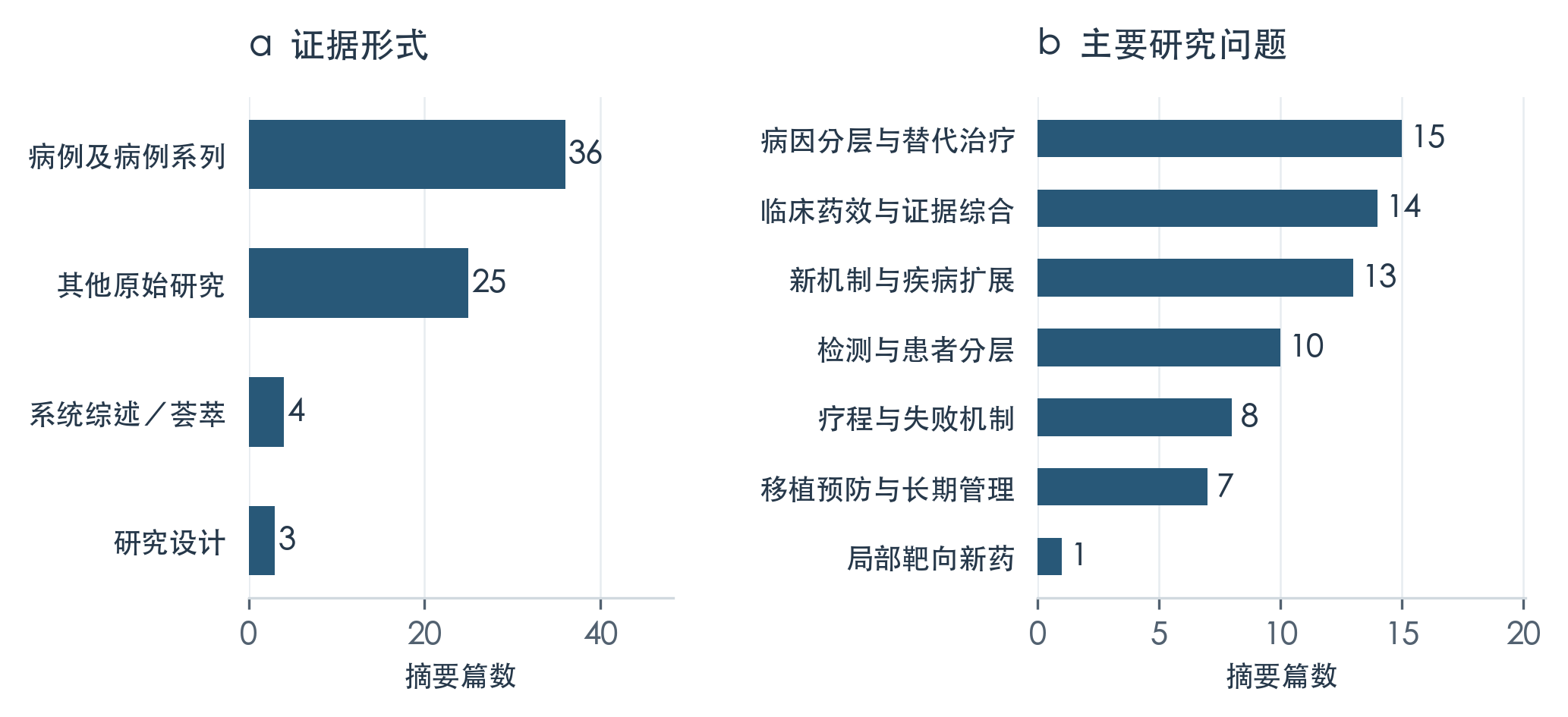
Figure 1 Evidence composition and research questions of the 68 core abstracts. Each panel sums to 68. Case and series reports: 36 (52.9%); other primary research includes trial analyses, observations, and mechanistic and methodological studies. Counts are from this manual re-screening and do not represent the number of independent trials.
Reading this batch of abstracts, one should see both the clinical data and the questions the data have not yet answered. Below, around the three main threads of tissue targeting, mechanism matching, and activity assessment, studies that mutually explain each other are selected, with sample size, follow-up time, and key effects marked.
I. Tissue targeting and local complement: the site of injury itself becomes the target
Research on complement-related kidney injury is paying further attention to the injury site itself. TH-PO0432 observed C3 cleavage and Bb production in serum-free cultured human podocytes; Cp40 or iptacopan intervention was accompanied by reduced senescence markers, cytoskeletal disarray, and apoptosis. This suggests podocyte-derived complement may participate in injury, rather than being merely a passive background of circulating complement deposition.
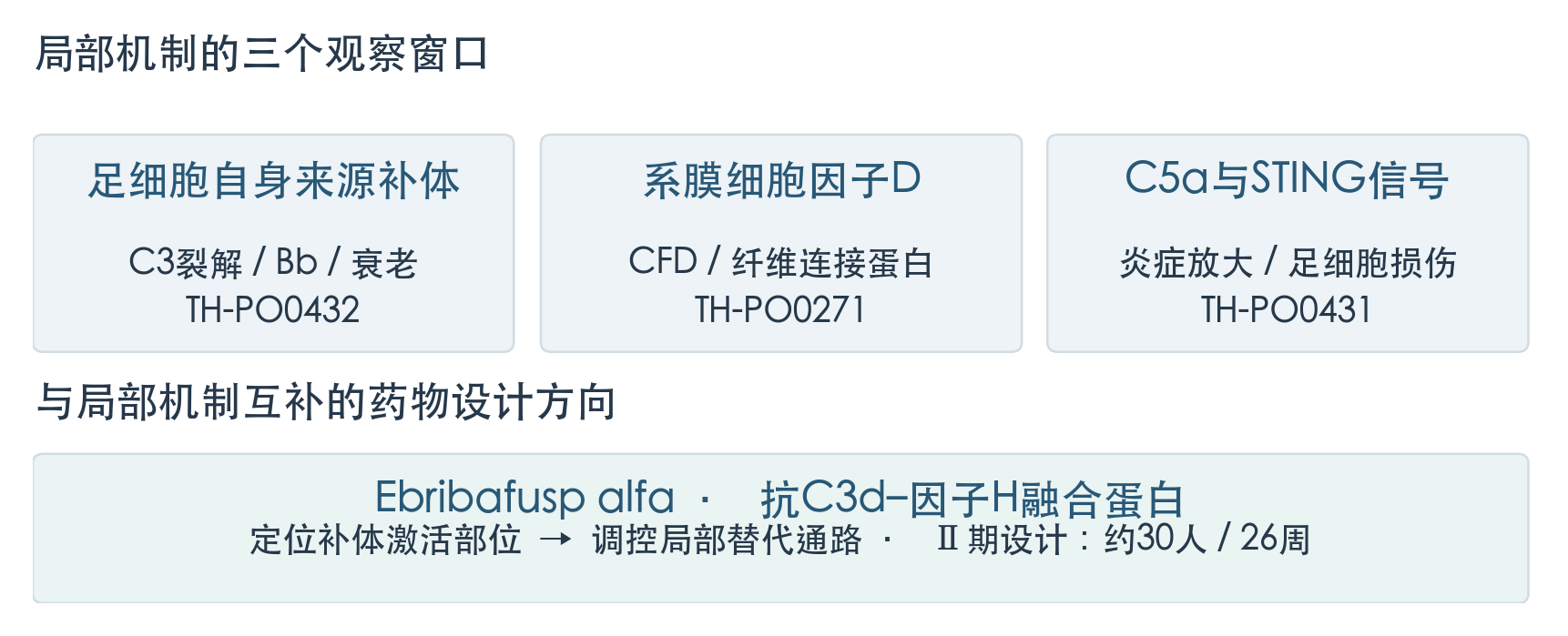
Figure 2 Research connection between local complement mechanisms and tissue-targeted drugs. Top: mechanistic signals across experimental systems; bottom: drug design and phase II study plans. The two should not be viewed as a validated continuous clinical causal chain.
Table 1 Key studies on local mechanisms and tissue targeting
| Abstracts and studies | Model or quantitative design | Key findings and evidence stage |
|---|---|---|
| TH-PO0432 podocyte complement | ADR handled for 24 hours; aging model extended by 48 hours; number of replicates not reported | C3 cleavage and Bb are associated with senescence; complement inhibition attenuates injury. Cell experiments. |
| TH-PO0271 mesangial factor D | Human kidney tissue + ADR mouse + cell knockdown; sample number not reported | CFD knockdown suppresses fibronectin upregulation. No clinical efficacy validated in FSGS yet. |
| TH-PO0431 C5a–STING | Patient metrics + animal/cell interventions; sample number not reported | C5a enhances STING signaling; C5aR1 blockade shows protective signals. Mechanistic study. |
| INFO12-SA Ebribafusp alfa | Phase II; about 30 participants; 450 mg subcutaneous weekly for 26 weeks | IgAN/LN/C3G basket trial; primary endpoint is safety. No efficacy results for this study yet. |
Ebribafusp alfa (INFO12-SA) uses an anti-C3d–factor H fusion design to modulate the alternative pathway at the site of complement activation. This phase II basket trial plans to enroll about 30 patients with IgAN, LN, and C3G, with 450 mg subcutaneous weekly for 26 weeks and safety as the primary endpoint; no efficacy results are available yet. Together with local mechanistic studies, it raises a translational question: can tissue injury be controlled more effectively while optimizing the degree of systemic complement suppression?
II. Mechanism matching and etiology intervention: the blockade position must return to disease mechanism
Proximal and terminal blockade each show signals
Analyses of two IgAN trials suggest that both proximal and terminal blockade can show notable signals; 'proximal is always superior to terminal' cannot summarize the findings across different diseases:
Table 2 Sample size, time, and key results of clinical studies
| Research and targets | Samples and time | Key quantitative results | How to interpret |
|---|---|---|---|
| FR-OR065 APPLAUSE-IgAN factor B | Randomized trial, N=477, 24 months | Urinary sC5b-9 and alternative pathway activity decreased; C3 increased; Gd-IgA1 essentially unchanged | Supports sustained efficacy; this abstract focuses on exploratory biomarkers. |
| TH-PO0471 I CAN C5 | Biomarker analysis, n=200, 34 weeks; changes as early as 2 weeks | Placebo-adjusted reduction in UPCR at 34 weeks: 43.4% (95% CI 33.5%–51.8%) | The 200 participants are a biomarker subset and should not be treated as the total population for UPCR analysis. |
| SA-PO0674 Iptacopan MAP factor B | 65 native kidneys, 22 relapses, up to 24 months | Annual eGFR slope change: +7.10 and +21.07; specific intervals shown in Figure 3 | Observational historical self-control; native-kidney group P=0.0629. |
| SA-PO0679 Pegcetacoplan C3/C3b | PK model from 14 studies; exposure–response from 3 nephrology studies | Free C3 inhibition >95% within dosing interval; steady-state exposure reached in about 4–8 weeks | Belongs to model/integrated analysis; not a new head-to-head trial. |
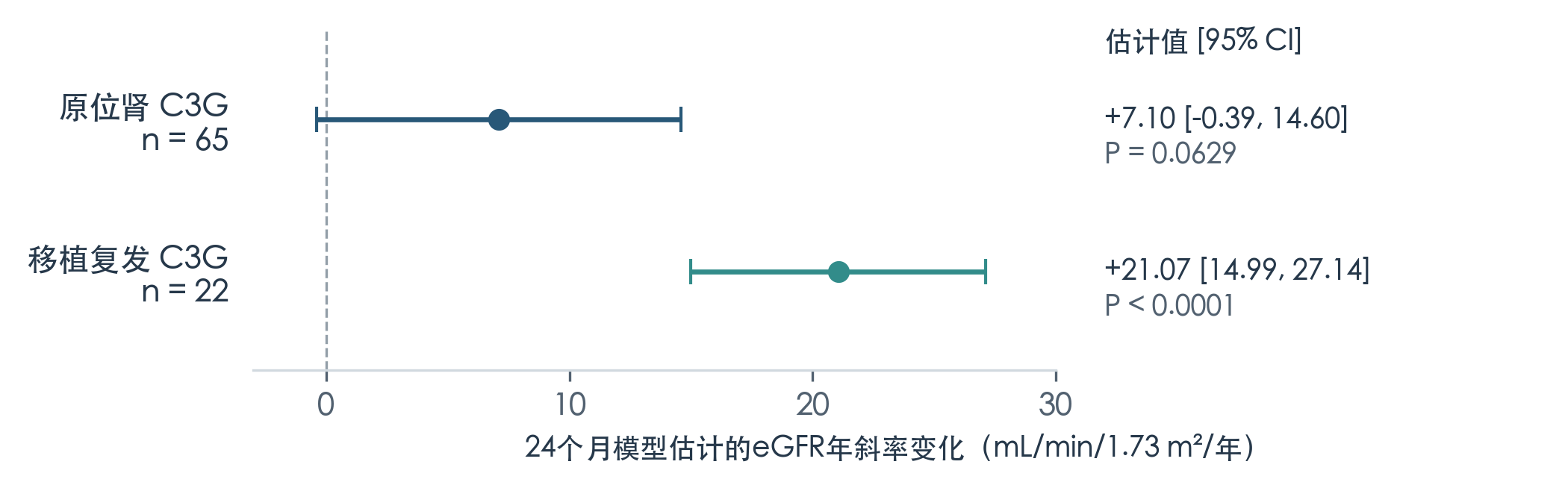
Figure 3 24-month model estimate for iptacopan MAP. Dots are pre- and post-treatment annual eGFR slope changes; horizontal lines are 95% CIs; not the post-treatment eGFR slope itself. The native-kidney group interval crosses 0; no between-group superiority test as shown in this figure was performed. Source: SA-PO0674.
C3G cases offer another perspective: 2 patients in SA-PO0738 progressed despite long-term eculizumab therapy, with repeat biopsy showing persistent C3 deposition; SA-PO0708 reported improvement after switching to C3 inhibition. This supports the role of persistent proximal activation but is insufficient to prove any drug class is superior for all patients.
The source of complement abnormalities can likewise become an intervention target
Choosing the blockade position requires tracing the drivers. Genetic variation, anti-complement autoantibodies, monoclonal proteins, and infection may form different complement-abnormality phenotypes. Some abstracts begin exploring reduction of these upstream drivers, while others remind us that dominant C3 deposition does not automatically mean long-term complement suppression is needed.
Table 3 Examples of studies from etiology to intervention site
| Pathological or etiologic clues | Representative abstracts and quantitative results | Proposed research directions | Evidence boundary |
|---|---|---|---|
| CFB variant-associated C3GN | SA-PO0743: 1 case with C3 rising from 6 to 39 mg/dL; proteinuria decreased 23% | Factor B blockade matched to pathological mechanism | Single case; short-term eGFR slope is prone to fluctuation. |
| Anti-complement autoantibodies | SA-PO0733: 8 cases in the RTX series, proteinuria decreased 61.8% at 9 months, P=0.055 | Reducing antibody sources through B-cell intervention | Change did not reach significance; cannot determine which antibody patient subgroup benefits. |
| Monoclonal protein or abnormal clone | SA-PO0744: 1 case came off dialysis after clone therapy; FR-PO1262: UPCR 12.86→1.46 mg/mg over 4 months | Targeting abnormal clones to address the source of complement abnormality | Case temporal association; lacks direct functional causal validation. |
| Infection triggers or mimics C3G | SA-PO0693: 1 case came off dialysis after antifungal treatment; SA-PO0716: 1 case of endocarditis improved after antimicrobial treatment | Etiology differentiation and infection management | Infection-associated GN and primary C3G have a diagnostic boundary. |
This gives 'mechanism matching' a twofold meaning: both choosing the right complement step and judging whether there is a persistent source of abnormal signals. Future research could study combination or sequential strategies of complement control and etiology treatment, but current small-sample evidence cannot prove combination is superior to monotherapy.
Treatment failure also needs to be dissected for causes
FR-PO0933 suggests inadequate drug exposure may contribute to non-response; SA-PO0767 shows persistent proteinuria after complement therapy may also arise from newly emerged podocytopathy; TH-PO1159 reports hematologic improvement after C5 inhibition but the patient remained dialysis-dependent. Non-response may correspond to target mismatch, inadequate exposure, comorbid lesions, or irreversible injury—and cannot be judged solely by proteinuria changes.
Intervention timing moved earlier, before transplant relapse
FR-PO0801 and FR-PO1158 attempted preventive pegcetacoplan at second transplant, with 6- and 2-month follow-up respectively; INFO21-TH (PRESERVE-C3Tx) plans to enroll about 30 high-risk patients, starting treatment at transplant with 24-month follow-up and protocol biopsies at 6, 12, and 24 months. Research is extending from 'rescue after relapse' to 'prevention before relapse,' but the preventive effect remains to be validated.
III. Complement activity and kidney injury assessment: where activation occurs and whether signals change
Serum C3/C4 can provide clues, but complement assessment still needs to answer: where activation occurs, which molecular forms are associated with injury, and whether these signals change after treatment? This study provides different observation windows from urine, cellular function, and tissue levels.
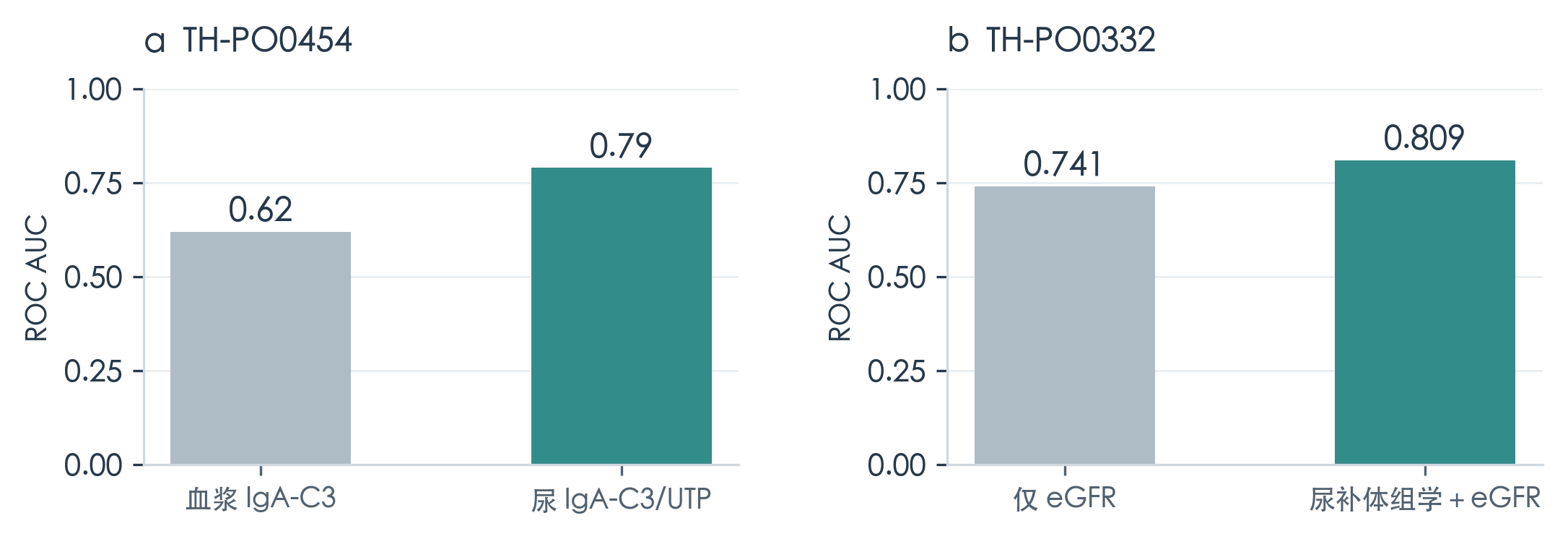
Figure 4 Within-study ROC AUC results. a: distinguishing IgAN from other glomerular diseases; sample size not reported in the abstract. b: distinguishing active from inactive disease/healthy controls; 27 CKD patients sampled repeatedly, plus 5 healthy controls. The two panels differ in population, objective, and model and cannot be ranked across studies. The abstract provided no AUC confidence interval; AUC is not diagnostic accuracy.
Table 4 Scale and validation progress of activity-assessment studies
| Abstracts and testing | Sample or material | Quantitative findings | Still to be resolved |
|---|---|---|---|
| TH-PO0454 urinary IgA-C3/UTP | Discovery, continuous live-test validation, and follow-up cohort; number of participants not reported | Urine/plasma AUC 0.79/0.62; high baseline value associated with <30% proteinuria reduction at 3 months, OR 4.2 [1.1–17.3] | Follow-up treatment is nefecon, etc.; not yet a predictor of complement drug response. |
| TH-PO1077 endothelial C5b-9 | 6 suspected TMA; 15 healthy controls | Among 3 untreated patients, 1 was positive and converted to negative after treatment | Sensitivity cannot be estimated from this; residual drug may affect in vitro assays. |
| TH-PO0332 urinary complement proteome | 27 patients, 1,416 visits; plus 5 healthy controls | AUC combined with eGFR 0.809; eGFR alone 0.741 | Number of visits is not independent number of persons; requires patient-level validation and external replication. |
| TH-PO0274 C3 fragment testing | Recombinant C3 and fragments; human mesangial cell platform | Monoclonal antibodies show broad cross-reactivity; combined testing can distinguish fragments containing C3c/C3d | Affinity does not equal fragment specificity; not yet a clinical diagnostic test. |
| TH-PO0999 tissue complement proteome | 65 DSA-positive/negative transplant biopsies | Each tissue compartment divided into 4 clusters; terminal complement associated with ECM and poor outcomes | Molecular subtyping has not yet validated drug-selection capability. |
The value of this group of studies lies in linking complement activation to specific injury. The next step needs to verify: whether these indicators provide information independent of proteinuria and eGFR, whether they can predict long-term outcomes, and whether they can identify beneficiaries of different interventions.
Conclusion
Putting the three main threads together reveals the same direction: complement research is shifting from 'whether to inhibit the pathway' to 'where, why, and to what extent to inhibit.' Tissue targeting aims to concentrate efficacy at the injury site; mechanism matching requires finding the driver first, then choosing the blockade step; activity assessment seeks molecular windows that reflect true injury. For testing and biomarker R&D, this means future needs are not just 'detecting complement' but 'detecting the right location, right form, and right treatment'—exactly where precision testing can play a role.
References
The main research results in this article are all from ASN Kidney Week 2026 conference abstracts, as follows:
- TH-PO0432 Podocyte-autonomous complement activation and senescence
- TH-PO0271 Mesangial complement factor D and FSGS sclerosis
- TH-PO0431 C5a and STING signaling
- INFO12-SA Ebribafusp alfa phase II basket trial
- FR-OR065 APPLAUSE-IgAN 24-month biomarkers
- TH-PO0471 I CAN prespecified biomarker analysis
- SA-PO0674 Iptacopan MAP 24-month follow-up
- SA-PO0679 Pegcetacoplan PK/PD modeling
- SA-PO0738 C3GN with progression despite long-term eculizumab
- SA-PO0708 C3GN switched to pegcetacoplan
- SA-PO0743 CFB variant and iptacopan response
- SA-PO0733 B-cell-directed therapy in C3G/IC-MPGN
- SA-PO0744 Clone-directed therapy for MGUS-associated C3GN
- FR-PO1262 CLL-associated C3GN
- SA-PO0693 Candida infection-associated C3GN
- SA-PO0716 Infective endocarditis mimicking C3G
- FR-PO0933 Low C5 inhibitor exposure and C3-targeted rescue
- SA-PO0767 C3GN with evolving podocytopathy
- TH-PO1159 Non-response in gemcitabine-associated TMA
- FR-PO0801 Prophylactic pegcetacoplan at second kidney transplant
- FR-PO1158 Peri-transplant pegcetacoplan
- INFO21-TH PRESERVE-C3Tx study design
- TH-PO0454 Urinary IgA-C3 complexes and disease severity
- TH-PO1077 Endothelial C5b-9 deposition assay
- TH-PO0332 Urinary complement proteome and disease activity
- TH-PO0274 C3 fragment detection and mesangial cell platform
- TH-PO0999 Complement proteins and transplant rejection phenotyping
This article is a compilation of industry frontier information and does not represent all ASN plenary or global research; different analyses of the same trial may be published separately; conference abstracts still need interpretation in light of subsequent full reports; any testing-related diagnosis and treatment decisions should follow medical advice.
Some original figures, videos and downloadable materials are provided in Chinese.