
Frontiers of Xenotransplantation | NEJM Case Report: Gene-edited pig kidney xenotransplantation brings new hope to patients with end-stage renal disease
Recently, the New England Journal of Medicine (NEJM) published a xenotransplantation case report from Massachusetts General Hospital in the United States. Researchers at the hospital successfully transplanted a complex gene-edited pig kidney into a 62-year-old male patient with end-stage renal disease. Although the patient only survived for 52 days, his death was not caused by graft rejection.
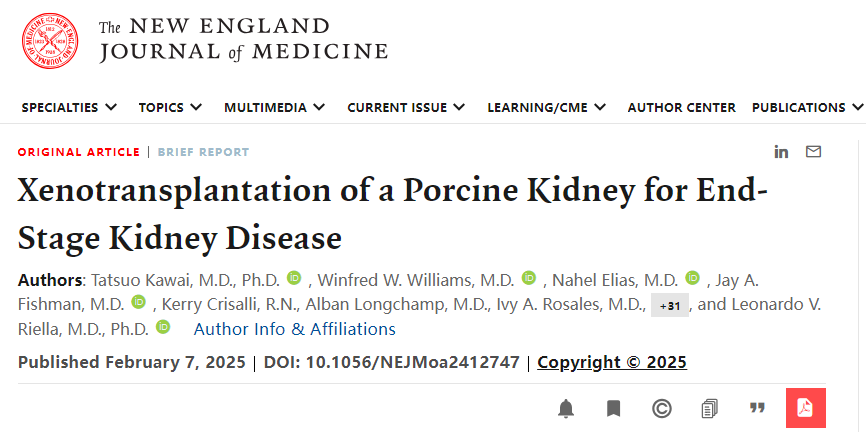
Recently, the New England Journal of Medicine (NEJM) published a xenotransplantation case report from Massachusetts General Hospital in the United States. Researchers at the hospital successfully transplanted a complex gene-edited pig kidney into a 62-year-old male patient with end-stage renal disease. Although the patient only survived for 52 days, his death was not caused by graft rejection.
This patient had received a kidney transplant due to uremia secondary to type II diabetes. However, the transplanted kidney failed due to BK virus-related nephropathy and recurrent diabetic nephropathy. Moreover, the patient had severe vascular disease and the dialysis access could not be re-established. At the same time, there was little hope for another allogeneic kidney transplant. After rigorous evaluation by the ethics committee and transplant experts, clinical experts at Massachusetts General Hospital decided to perform a gene-edited pig kidney transplant on the patient.
Breakthrough treatments: from gene editing to clinical practice
The research team used CRISPR-CAS9 technology to gene edit pigs and created a pig kidney organ carrying 69 genome edits, including removal of three major carbohydrate antigens, porcine endogenous retrovirus, and transfer of seven human genes to reduce immune rejection and improve organ immune tolerance.
Clinical practice: from surgical success to immune management breakthroughs
After transplantation, the gene-edited pig kidneys quickly recovered function: urine output stabilized at 1.5-2L/day, and creatinine level dropped from 11.8 mg/dL before surgery to 2.2 mg/dL on the 6th day after surgery. The immunosuppressive regimen used antithymocyte globulin (ATG) combined with anti-CD154 monoclonal antibody and low-dose tacrolimus/mycophenolic acid, which initially controlled immune rejection.
Challenges and Responses: Precision Intervention for Acute Rejection
On the 8th postoperative day, the patient developed elevated creatinine (increased from 2.2mg/d on the 7th day to 2.9mg/dL), fever, graft tenderness, and decreased urine output. The biopsy confirmed acute T cell-mediated rejection (Baff grade 2A). The research team used glucocorticoid pulse (methylprednisolone 500 mg × 2 times) and a second ATG infusion (1.5 mg/kg) and complement C3 inhibitor (Pegcetacoplan) combined intervention, the rejection was finally reversed, the creatinine level fell back to 2.5 mg/dL, and the patient was successfully discharged from the hospital on the 18th day after surgery.
Regrets and Enlightenments: Cardiovascular events become a key limiting factor
Although the patient's renal function continued to improve (eGFR 40-50 mL/min/1.73 m²) and the creatinine level remained in the range of 1.5-2.0 mg/dL after discharge, the patient unfortunately passed away due to a sudden cardiac event on day 52. Autopsy revealed severe calcification of the coronary arteries with ventricular scarring, but no xenograft rejection or evidence. This outcome suggests that patients with end-stage renal disease often have severe cardiovascular diseases, and cardiac risk stratification needs to be strengthened in preoperative evaluation and perioperative management in the future.
Scientific significance and future directions
This case proves for the first time that the gene-edited pig kidney can tolerate the human immune system. The pig renin-angiotensin system (RAAS) partially compensates in the human body and maintains stable blood pressure (average 131/70 mmHg). It shows good cross-species physiological compatibility. It also verifies the feasibility of targeted T cell depletion combined with complement inhibition to control xenogeneic rejection, and injects cardiotonic agents into the field of xenotransplantation. In addition, xenotransplantation faces some issues to be solved, including: the safety of cross-species transmission of swine-derived pathogens; optimizing immune tolerance such as using less toxic immunosuppressive regimens (such as chimeric antigen receptor regulatory T cell therapy); and further simulating the microenvironment of human organs through gene editing (such as humanization of vascular endothelial cells).
In the context of the global organ shortage crisis, xenotransplantation has moved from the laboratory into clinical practice. Although this case failed to achieve long-term survival, it provides the possibility of "transitional life support" for patients with high-risk end-stage renal disease. With the iteration of gene editing technology and immune regulation strategies, xenogeneic organs are expected to become a routine choice in human transplant medicine, reshaping the survival hopes of millions of patients.
Case full text link:https://www.nejm.org/doi/full/10.1056/NEJMoa2412747
Some original figures, videos and downloadable materials are provided in Chinese.