
ATC2022 in-depth interpretation (1): ddcfDNA clinical usage scenarios and usage experience summary
As the clinical application of ddcfDNA in kidney transplantation continues to expand, transplant centers around the world continue to deepen their understanding of the synergistic value between ddcfDNA and the traditional gold standard renal biopsy, and continue to summarize the experience of ddcfDNA in clinical usage scenarios and clinical benefits. Fruitful research results have emerged in the past year. There are four articles in this ATC
As the clinical application of ddcfDNA in kidney transplantation continues to expand, transplant centers around the world continue to deepen their understanding of the synergistic value between ddcfDNA and the traditional gold standard renal biopsy, and continue to summarize the experience of ddcfDNA in clinical usage scenarios and clinical benefits. Fruitful research results have emerged in the past year. This ATC has four representative studies, which we will interpret next.
First Research: PassddcfDNACan research reduce clinically unnecessary needle biopsies?
From University Hospitals Cleveland Medical Center, Cleveland, USA Cleveland, OH) research answers this question in the affirmative.
The center has been carrying out procedural biopsies, performing puncture biopsies at four times: "zero point/before perfusion", "10-14 days after surgery", "3 months after surgery" and "12 months after surgery" of kidney transplantation. A retrospective study found that ddcfDNA may be helpful in clinical decision-making in post-transplant DGF/SGF patients.eliminate near60%unnecessary biopsy.
Analysis of a total of 67 ddcfDNA and pathology paired samples (7 possibly ABMR) from 55 patients showed that: 40 of them were negative with both ddcfDNA and pathology biopsy results, 2 were ddcfDNA positive and biopsy negative, 4 pathology showed Banff 1A rejection but ddcfDNA results were negative, 6 pathology showed borderline rejection patients also had negative ddcfDNA results; 6 Banff Positive ddcfDNA and biopsy results in grade 1A or higher rejection and 2 borderline rejections[Figure 1]. If only Banff grade 1A or higher rejection was considered, the negative predictive value (NPV) of ddcfDNA was 91.3% and the specificity was 95.5%. If critical rejection is included, the NPV of ddcfDNA drops to 82.3%.
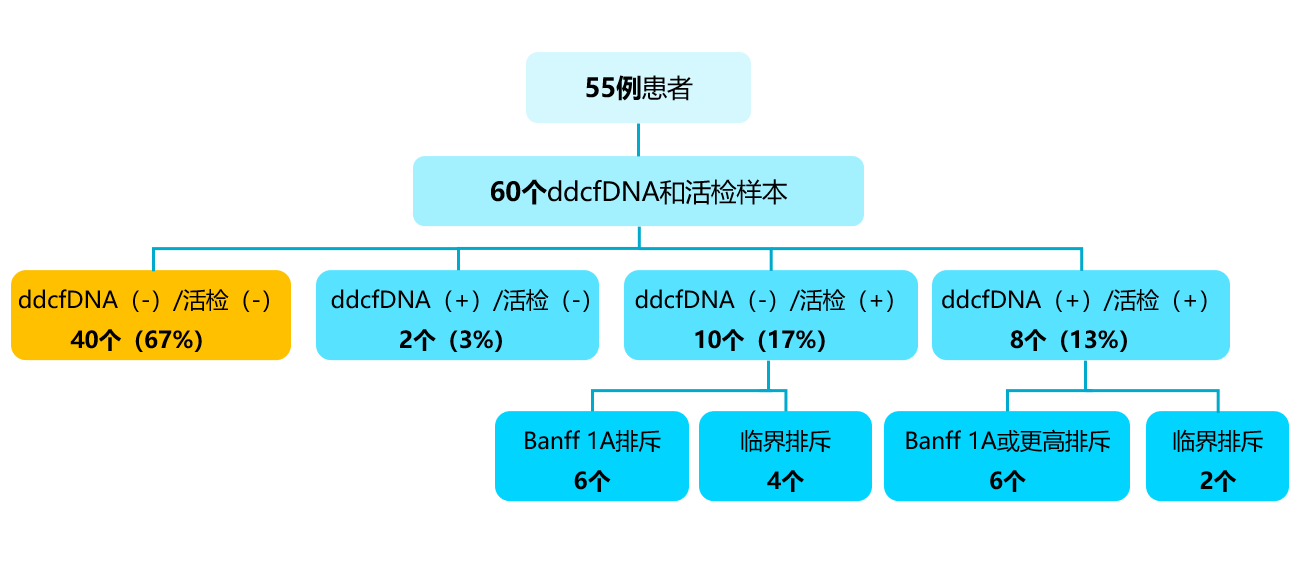
[Figure 1]
Second Research: Since passedddcfDNATesting can reduce unnecessary needle biopsies, so can it be carried out clinically?ddcfDNAEarly screening, through referenceddcfDNAHow to perform targeted needle biopsy based on the changes in indications of the results to improve the efficiency and profitability of pathological biopsy?
from the University of Maryland School of Medicine, Baltimore, USA Research from centers such as MD) has shown that clinical biopsy guidance under ddcfDNA monitoring can improve the “Histological Yield and Actionable Findings”.
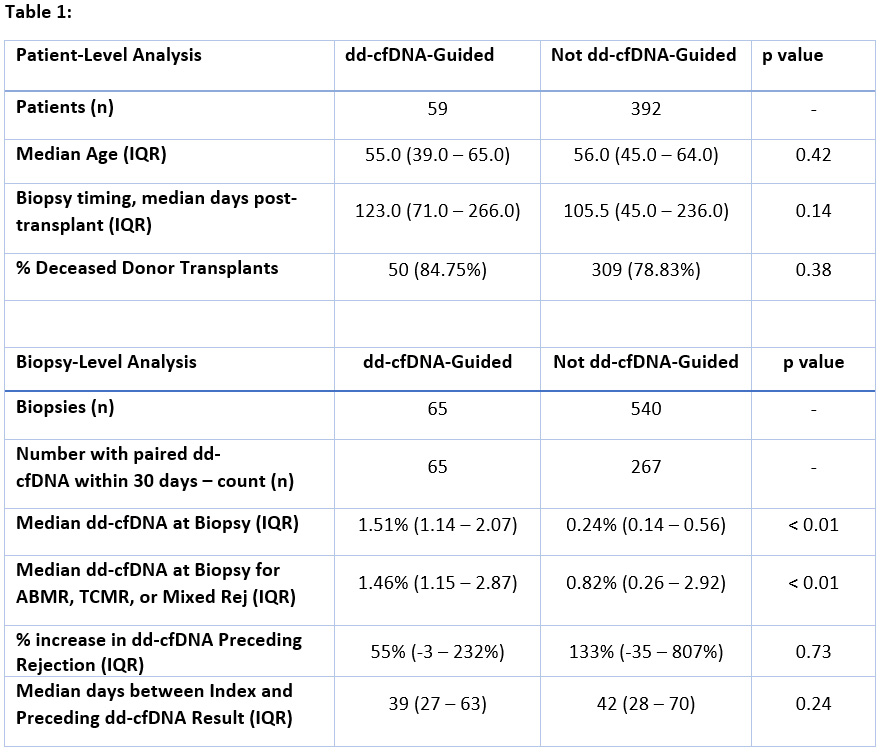
This multi-center study followed 1663 kidney transplant recipients through ddcfDNA testing and collected a total of 540 pathological results of traditional clinically indicated biopsies and 65 pathological biopsy results guided by elevated ddcfDNA. There were no significant differences in age, percentage of deceased donors, and post-transplantation biopsy time between groups.[Table 1]。
This historical image is currently unavailable.Open original image

ddcfDNA-guided biopsy significantly increased the detection rate of rejection (48% vs 29%) and had fewer ATI/ATN cases (12% vs 22%) compared with traditional indication biopsy (p < 0.05)[Figure 2]. In ddcfDNA-guided rejection biopsies (ABMR, TCMR, or mixed array), the median ddcfDNA value was 1.46% (IQR: 1.15–2.87). Among the 267 pathological results of biopsies guided by traditional indicators but without elevated ddcfDNA, the median ddcfDNA value was 0.24%. Among the samples with rejection, the median ddcfDNA value was 0.82%, and the detection value increased by 133% compared with before the rejection occurred.
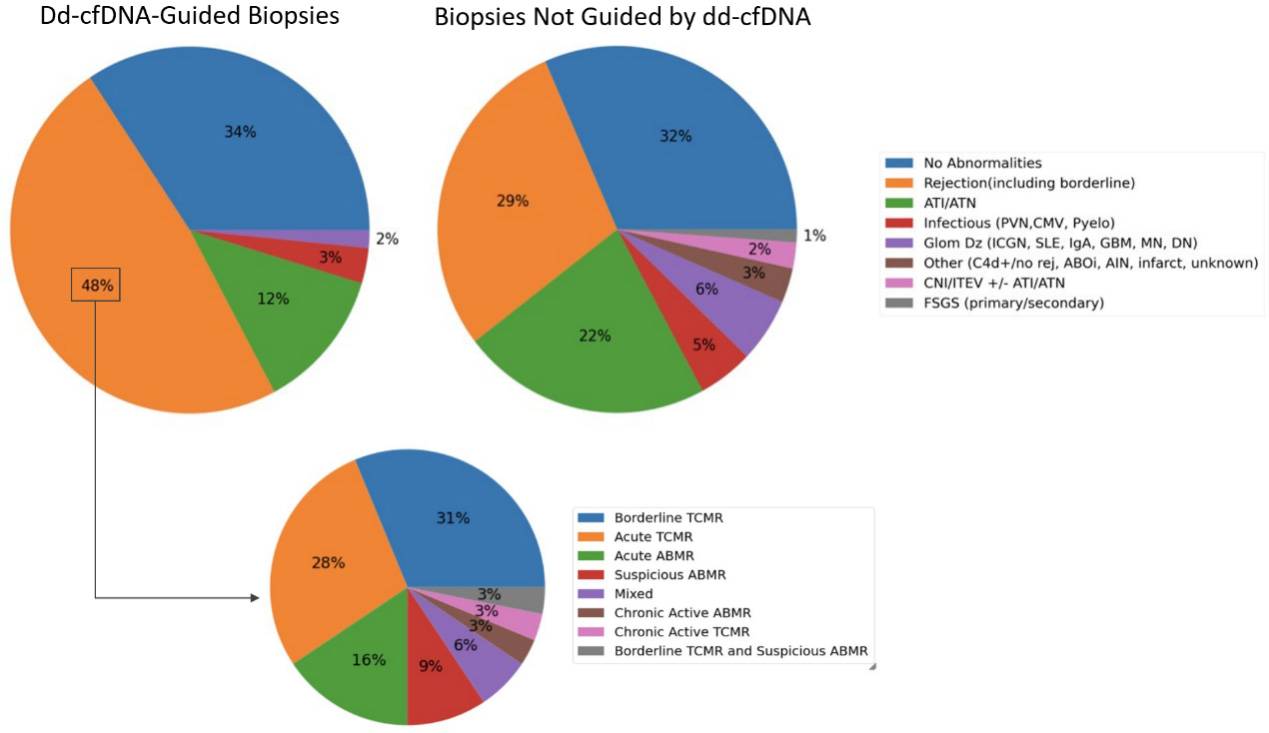 [Figure 2]
Therefore,ddcfDNATesting can add decision-making support to biopsy.Even if other clinical factors are present to guide biopsy decisions, lower ddcfDNA values may help avoid biopsy.
Third Research: ddcfDNACan the test detect rejection that other clinical indicators fail to indicate?
from Ochsner Foundation Hospital, New Orleans, LA, known as “Modern With the title "Medicine Needs Modern Technology Tools", the dynamic ddcfDNA monitoring results of three kidney transplant recipients with stable creatinine were reported, confirming the value of ddcfDNA detection in early screening of subclinical rejection.
Case 1: DCD kidney transplantation due to ESRD secondary to HIV infection. Postoperative creatinine stabilized at 1.1 mg/dL to 1.2 mg/dL. This case underwent ddcfDNA testing at 1, 2, 3, 4, 6, and 9 months after transplantation. The results showed that the ddcfDNA detection value from 1 to 6 months was < 0.21%, indicating stable renal function. However, when tested at the 9th month, the ddcfDNA value increased to 4.5%, indicating that the donor kidney may be damaged.At this time, the case’s creatinine is still stable at1.2 mg / dL, DSA IIClass weak positive. Although creatinine was stable and DSA levels were low at this time, due to the sharp increase in ddcfDNA values, a clinical biopsy was performed, and the results suggested acute TCMR and acute ABMR.
Case 2: This is a patient with repeated kidney transplantation. The postoperative creatinine was stable at 1.0~11.3 mg/dL, and the ddcfDNA values in the first and second months were < 0.21% and 0.32% respectively. At the 3rd month,ddcfDNAvalue rises to0.78%,DSAis negative.This case underwent biopsy due to an elevated ddcfDNA value, suggesting acute ABMR.[Figure 3]。
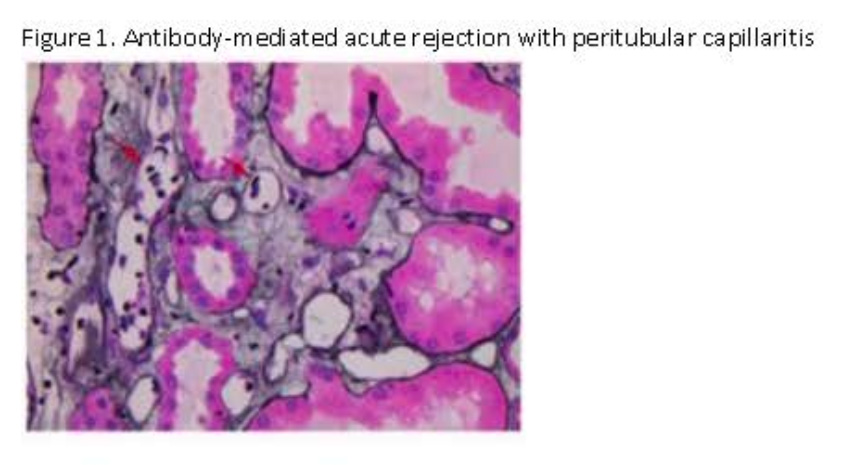
[Figure 3]
Case 3: There was a history of ESRD secondary to hypertension. Several months after renal transplantation, the patient developed acute renal failure (creatinine increased from 1.2 mg/dL to 1.7 mg/dL). Biopsy showed acute ABMR and TCMR, and he was treated. He received monthly ddcfDNA monitoring for 1 year after transplantation. The first ddcfDNA value was 1.9%, indicating possible kidney transplant damage. And the ddcfDNA monitoring results show that the ddcfDNA value is on the rise, reaching as high as 4.1%.The creatinine is stable at1.2 mg/dL-1.3 mg/dL. At this time, the biopsy showed acute ABMR and chronic active antibody rejection. This case was treated with ABMR and was treated with monthly rituximab for 6 months. During the treatment period, ddcfDNA showed a downward trend[Figure 4]。
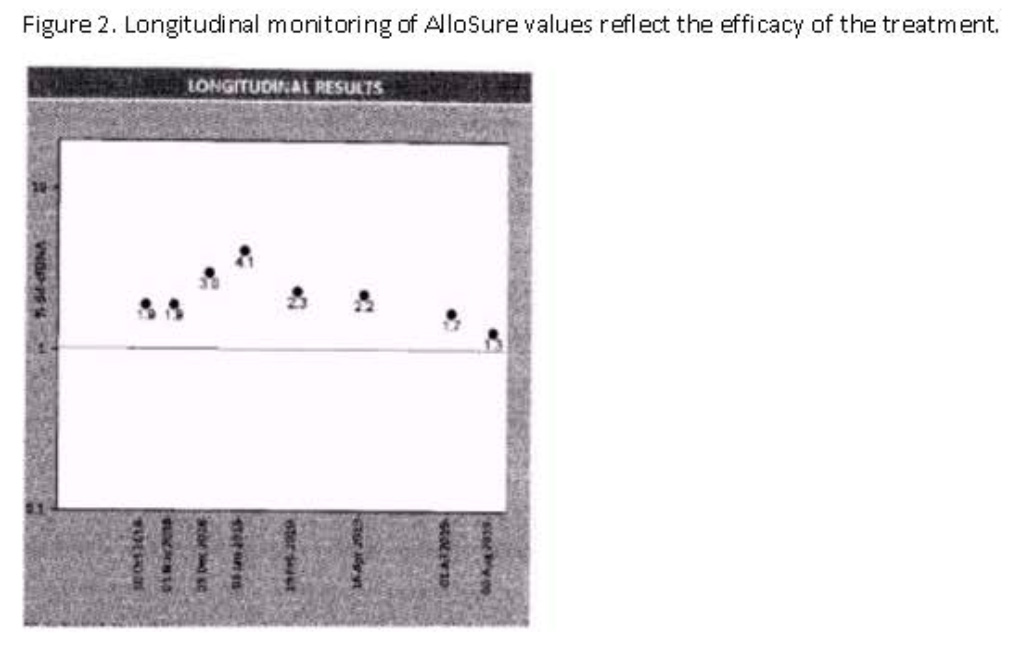
[Figure 4]
Fourth Research: singleddcfDNATesting can detect early subclinical rejection, so useddcfDNACan combined testing with gene expression improve the detection rate of subclinical rejection?
Baystate Medical Center, Springfield, MA, USA, shared their early experience in using a combination of gene expression (TG) and ddcfDNA (TRAC) to monitor rejection (OmniGrafs) in patients with stable renal function. Double negativity for TG and ddcfDNA (<0.7%) excludes subclinical rejection (NPV 94%), whereas double positivity for TG and ddcfDNA (≥0.7%) suggests the need for further clinical evaluation (PPV 89%)[Figure 5], such as needle biopsy, DSA detection, etc.
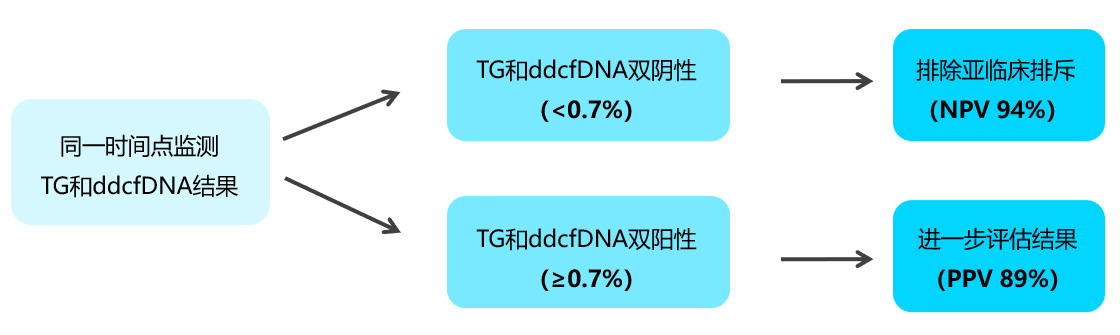
[Figure 5]
Prior to the use of OmniGraf monitoring, 13 kidney transplant recipients were continuously monitored using TG and ddcfDNA simultaneously or separately. Further evaluation of the discordant results revealed that among the 4 negative TG/positive ddcfDNA, 3 were positive for DSA, and only 50% of the patients were positive for proteinuria. Based on OmniGraf monitoring, 6 of 8 kidney transplant recipients avoided a procedural biopsy at 3 months after transplantation.
In this study, 35 kidney transplant recipients received 36 OmniGrafs tests. Among them, 25 cases were double negative (TG negative/ddcfDNA negative), confirming the adequacy of immunosuppression. 10 cases were inconsistent (6 cases were TG positive/ddcfDNA negative; 4 cases were TG negative/ddcfDNA positive), and 1 case was double positive (TG positive/ddcfDNA positive), requiring further examination.[Figure 6]。
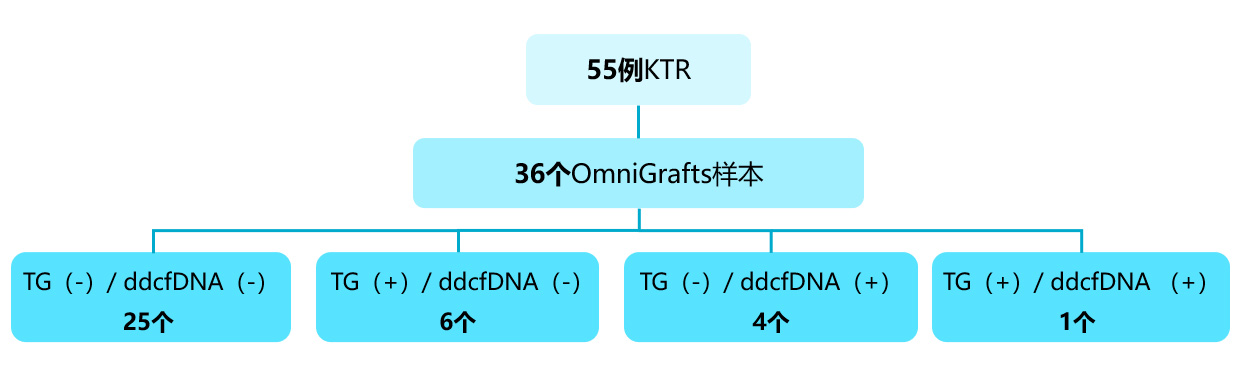
[Figure 6]
The use of combined gene expression and ddcfDNA monitoring enabled the exclusion of subclinical acute rejection without the use of needle biopsy at 3 and 12 months after transplantation, confirming the adequacy of immunosuppression and providing synergistic information to be considered alongside other clinical data such as DSA. The center believes a larger study is necessary to determine the optimal detection frequency and method for OmniGraf.
Based on the above four research results, the clinical use scenarios and experiences of ddcfDNA detection are summarized as follows:
1. ddcfDNA detection can reduce unnecessary puncture biopsies;
2. Biopsy guided by ddcfDNA testing can improve the profitability and efficiency of pathological results;
3. Using ddcfDNA or ddcfDNA-related combination testing can detect subclinical rejection early.
Some original figures, videos and downloadable materials are provided in Chinese.