
ATC 2021: dd-cfDNA for Subclinical Screening (Part 3)
The clinical manifestations of subclinical rejection are not obvious, and procedural biopsy is currently the main method to detect subclinical rejection. However, its application is limited due to patient compliance and the risk of complications. Public literature shows that less than 25% of US transplant centers are performing procedural biopsies. Therefore, it is necessary to find non-invasive biomarkers that can indicate rejection to assist early diagnosis.
The clinical manifestations of subclinical rejection are not obvious, and procedural biopsy is currently the main method to detect subclinical rejection. However, its application is limited due to patient compliance and the risk of complications. Public literature shows that less than 25% of US transplant centers are performing procedural biopsies. Therefore, it has become a clinical consensus to find non-invasive biomarkers that can indicate rejection to assist in the diagnosis of early subclinical rejection.This article interprets the research on the correlation between donor-derived cell-free DNA (ddcfDNA) and subclinical rejection at the 2021 ATC meeting.
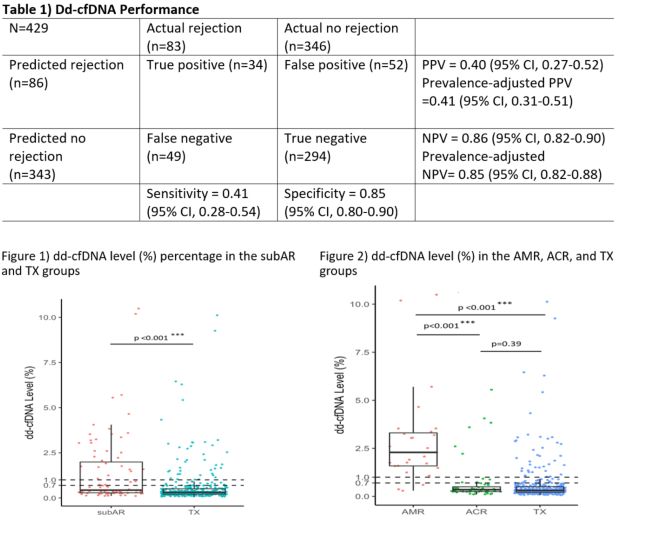
Professor Park S's team at the Northwestern University Kidney Transplantation Center conducted biopsy results on 208 patients with stable postoperative renal function, showing that 83 (19.3%) of them developed subclinical rejection (subAR), including 51 (61.4%) borderline cell-mediated rejection, 27 (32.5%) antibody-mediated rejection (AMR), and 5 (6%) Banff IA cell-mediated rejection. When the blood ddcfDNA threshold was 0.7%, the positive predictive value was 40% and the negative predictive value was 86% (Figure 1). Among them, the AMR group was significantly higher than the acute cellular rejection (ACR) group (p<0.001) or stable (TX) group (p<0.001). Among the 27 cases of subAMR, 24 patients had positive ddcfDNA results, and the positive predictive value of blood ddcfDNA alone for AMR was 88.9%. Therefore, a simple blood ddcfDNA test can effectively screen for AMR, but it is of little significance for screening for subclinical cell-mediated rejection.
(Figure 1)
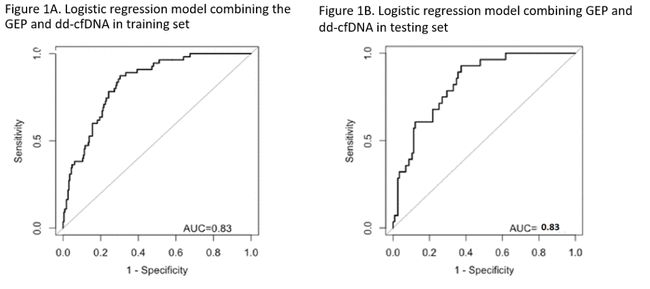
Professor Park S further combined the results of blood expression profiling (GEP) and showed that the area under the curve of ddcfDNA's diagnostic performance for subclinical rejection can be improved from 0.67 to 0.83 (Figure 2).This further illustrates the limitations of screening for subclinical cell-mediated rejection through blood ddcfDNA alone.
(Figure 2)
The team of Professor DasariM of the University of Washington Transplantation Center retrospectively analyzed the blood ddcfDNA test results of 227 kidney transplant patients 4 months after surgery. The ddcfDNA test results of 18 patients (7.9%) were positive, and pathological biopsy results were retrospectively available in 10 of them. Among these 10 patients, 2 underwent indicated needle biopsy, and the other 8 were all patients with stable renal function, and the pathological results all showed rejection (specificity reached 100%): 4 were antibody-mediated rejection, 2 were cell-mediated rejection, and 2 were considered mixed rejection. The clinical serum creatinine and urinary protein of these 8 patients were normal, and only 1 patient had ever been DSA positive.From here we can see why the blood ddcfDNA test performed better in Professor DasariM's study, because there were only 2 (25%) cellular rejection patients in Professor Dasari's study, while the proportion of cellular rejection patients in Professor ParkS's study was 67.4% (56 cases).
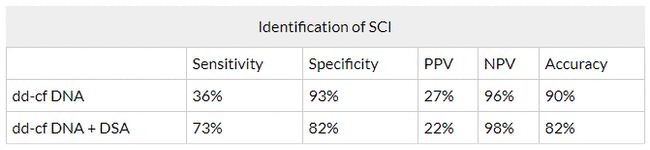
Professor Jain R’s team at the University of Alabama at Birmingham Transplantation Center hopes to improve the screening ability of blood ddcfDNA for subclinical rejection by combining donor-specific antibodies (DSA). It retrospectively analyzed the results of 174 patients with procedural biopsy (the type of rejection was not specified in the article, and it was inferred from the title that it was only antibody-mediated rejection), showing that the specificity of diagnosing rejection through ddcfDNA detection alone was 93%, and the sensitivity only missed 2.29% of subclinical rejection patients; when combined with DSA, the negative predictive value reached 98%, and only missed 1.72% of subclinical rejection patients (Table 1). Because this researchThe study did not explain the distribution of rejection types. Therefore, the author believes that the simple blood ddcfDNA test has such good diagnostic performance and needs further elaboration.
(Table 1)
Summary:At present, there is good data support for screening antibody-mediated rejection simply through blood ddcfDNA testing, but the results for screening critical/acute cell-mediated rejection are not ideal.In the future, it may be necessary to simultaneously detect the relative and absolute values of ddcfDNA in hematuria to improve the screening of subclinical rejection.。
Some original figures, videos and downloadable materials are provided in Chinese.