
Science Frontier: Regarding ddcfDNA, what was discussed at the ATC meeting? (3)
In the last two issues, the editor introduced to you the new progress of donor-derived cell-free DNA (ddcfDNA) in transplantation liquid biopsy at the ATC conference. In this issue, the editor will continue to introduce it in detail.
In the last two issues, the editor introduced to you the new progress of donor-derived cell-free DNA (ddcfDNA) in transplantation liquid biopsy at the ATC conference. In this issue, the editor will continue to introduce it in detail.
Jordan S, Sood P, Bromberg J, Brennan D. The Use of dd-cfDNA as a Predictive Tool for Future Proteinuria [abstract]. Am J Transplant. 2020; 20 (suppl 3).
Proteinuria needs to be monitored regularly after transplantation. The occurrence of proteinuria indicates that the transplanted kidney has been damaged. Experts from transplant centers such as the University of Pittsburgh Medical Center systematically studied whether elevated ddcfDNA could predict the occurrence of proteinuria, thereby facilitating long-term monitoring of the health status of transplanted kidneys.
This study enrolled 99 patients and measured the ddcfDNA content from 14 days to 1 year after transplantation. Among them, 20 patients had ddcfDNA>1%, and 79 patients had stable ddcfDNA. At 2 years after transplantation, patients with ddcfDNA >1% were more likely to develop proteinuria than patients with stable ddcfDNA (0% vs 20%, p=0.001). Further analysis showed that 82 patients had no obvious proteinuria (++) within 1 year after surgery. Among them, patients with elevated ddcfDNA within one year were more likely to develop proteinuria in the second year, but due to the small sample size, there was no statistically significant difference (8% vs 0%, p=0.146).
Although the occurrence and progression of proteinuria are caused by multiple factors, the increase in ddcfDNA in patients within 1 year after transplantation is related to the occurrence of proteinuria in the second year. As a biomarker of transplanted kidney injury, ddcfDNA can not only be used to detect acute rejection, but can also be used as a routine monitoring tool combined with other indicators of immune damage to predict the long-term health status of the transplanted kidney.
Gillespie M, Lim K, Vo A, Huang E, Ammerman N, Peng A, Najjar R, Sethi S, Jordan S. Donor-Derived Cell-Free DNA Levels During Early Rejection after Kidney Transplant May Be Impacted by Type of Induction Agent Received [abstract]. Am J Transplant. 2020; 20 (suppl 3).
ddcfDNA is a new biomarker for monitoring kidney transplant rejection. Currently, it is unclear whether ddcfDNA is affected by induction therapy. Cedars-Sinai Medical Center Transplant Center has conducted a systematic study on this.
This study enrolled 175 samples (154 patients) within 1 month after transplantation, 147 samples were first-time transplantation (27 cases with biopsy-confirmed rejection), and 28 were repeated transplantation (5 cases with biopsy-confirmed rejection) samples. The ddcfDNA content was detected within 1 month after transplantation. Among first-time transplant patients: among non-BPAR patients who underwent induction therapy with alemtuzumab (C1H), thymoglobulin (ATG), and basiliximab (IL2), the median ddcfDNA levels in patients were 0.34%, 0.43%, and 0.33%, respectively. When BPAR patients used low-dose C1H, ATG, and IL2, the median ddcfDNA levels were 1.1%, 1.8%, and 2.1%, respectively.
For patients with repeated transplantation, only C1H induction therapy was performed without ATG and IL2 induction therapy. Upon C1H induction therapy, the median ddcfDNA was 0.6% in non-BPAR patients and 0.95% in BPAR patients.
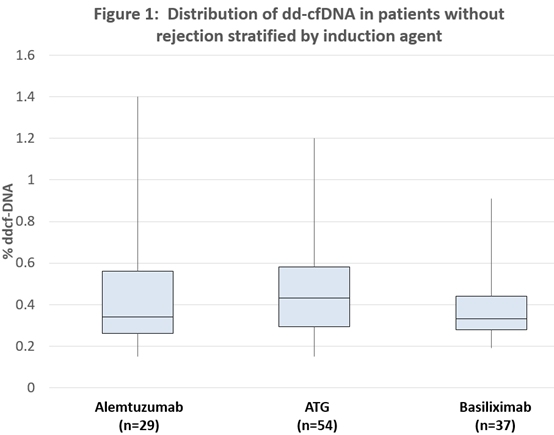
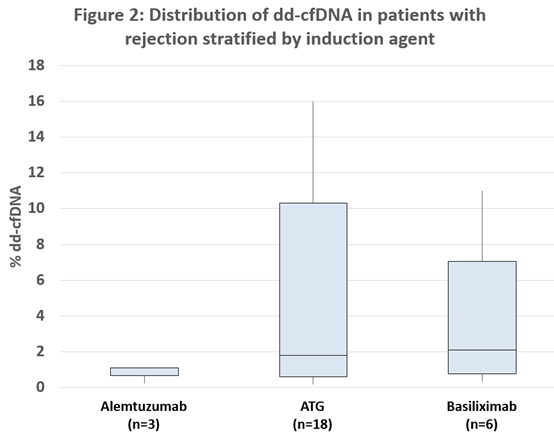
The results showed that within 1 month after transplantation, for non-BPAR patients with first kidney transplantation, there was no change in the ddcfDNA content in patients with different induction treatments. For BPAR patients, the ddcfDNA in patients with depleting induction (especially C1H) was significantly lower than that in patients with non-depleting induction. Lower levels of ddcfDNA in patients are related to the use of C1H. Depleting induction can prompt the recipient's own cells to accelerate apoptosis and necrosis to release cfDNA, thereby reducing the proportion of ddcfDNA. (No statistical analysis was performed in this study.)
Gauthier P, Aleshin A, Shchegrova S, Mckenna T, Kalashnikova E, Sharma S, Sethi H, Salari R, Swenerton R, Demko Z, Zimmermann B, Billings P. Factors Influencing Background Cell-Free DNA Levels: Implications for Donor-Derived Cell-Free DNA Assessment in Transplant Patients [abstract]. Am J Transplant. 2020; 20 (suppl 3).
The main pathological feature of chronic active T cell-mediated rejection (CACMR) is inflammation in areas of interstitial fibrosis and tubular atrophy (i-IFTA). Whether i-IFTA is related to immunodeficiency is still controversial, and it is also unknown whether immunosuppressive therapy is effective in CACMR. Cedars-Sinai Medical Center Transplantation Center studied the relationship between response to CACMR therapy and histopathological scores, and the long-term relationship between ddcfDNA and renal allograft function after treatment.
This study enrolled 51 patients with CACMR, 31 patients had eGFR ≥ 10 ml/min/1.73 m2, of which 29 patients (21 with steroids and 8 with ATG) received treatment, and 2 patients did not receive treatment. None of the untreated patients improved. On steroid therapy, 48% of patients experienced partial (7/21) or complete (3/21) improvement after two weeks. On ATG treatment, 25% (2/8) of patients experienced partial or no improvement. Among the patients who improved after treatment, 8 patients were followed up for 3 months, and 4 of them had sustained improvement. There is no correlation between CACMR pathological scores (t score, ci + ct scores, Banff i score) and treatment effect. dd-cfDNA changes were detected within 30 days of biopsy in 19/51 patients. Using linear mixed effects model, when dd-cfDNA ≤ 1.2%, eGFR is stable in the long term [eGFR slope: 1.6 (-6.9 to 10.2) ml/min/1.73 m2/year], while when dd-cfDNA ≥ 1.3%, eGFR shows a downward trend after surgery [slope: -21.1 (-39.9 to -2.2) ml/min/1.73 m2/year; p for interaction 0.03].
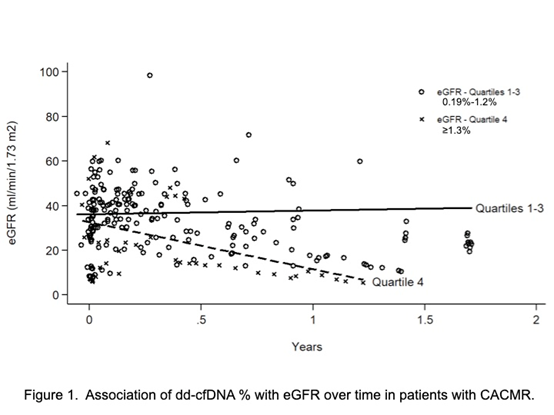
Treatment of CACMR is heterogeneous. Continued steroid therapy can improve symptoms in some patients with CACMR. There is no obvious way to identify patients who do not respond to treatment with steroids or ATG. ddcfDNA can be used as a predictor of renal function. In the future, molecular markers and histopathological characteristics can be combined to predict the efficacy of CACMR treatment.
Liu L, Liu H, Liu F, Shu L, Peng L. The Level of Plasm Donor-Derived Cell-Free DNA in Kidney Transplant Patients with Severe Pneumonia [abstract]. Am J Transplant. 2020; 20 (suppl 3).
Pulmonary infection is one of the common complications after kidney transplantation. ddcfDNA is a novel biomarker for monitoring graft damage. However, the changes in ddcfDNA in kidney transplant patients with severe pneumonia are unclear. In order to further study the specificity of ddcfDNA for rejection detection. Experts from the Transplantation Center of the Second Xiangya Hospital conducted a systematic study on this.
This study enrolled 55 patients, of whom 42 were not infected with pneumonia (stable group) and 13 were diagnosed with pneumonia (IDSA/ATS criteria). The first day of treatment (22 pathogenic bacteria were detected) was set as the infection group, and the 7th day of treatment (22 pathogenic bacteria were negative) was set as the post-treatment remission group. The results showed that the average cfDNA total concentrations of the infection group, remission group and stable group were 222±78.9 ng/mL, 77±34.5ng/mL and 60±24.4ng/mL respectively. There was a significant difference between the infection group and the remission/stable group (p=0.024), and there was no significant difference between the remission group and the stable group (p>0.05). The average values of ddcfDNA% in the simultaneous infection group, remission group and stable group were 0.58%±0.12%, 0.58%±0.16%, and 0.54%±0.08% respectively. There was no significant difference between the three groups (p>0.05). The absolute values of ddcfDNA (genomics cp/mL) corresponding to each group were 94.6±29.26cp/mL, 56.41±13.43cp/mL, and 49.81±10.09cp/mL. There was a significant difference between the infection group and the remission/stable group (p=0.044), while there was no significant difference between the remission and stable group (p=0.423).
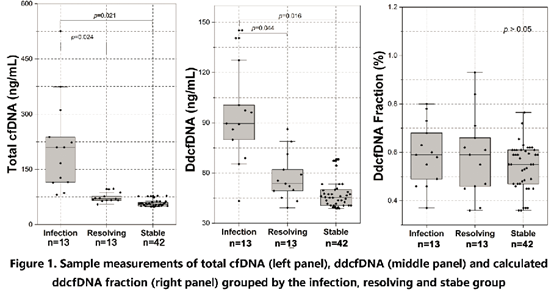
The results suggest that severe pneumonia can cause transplanted kidney damage and increase the absolute value of ddcfDNA in serum, but there is no significant change in the relative value. The relative value of serum ddcfDNA may be affected by the release of cfDNA (recipient cfDNA) from lymphocyte apoptosis and necrosis. Therefore, the relative value of ddcfDNA is used to monitor rejection, which is not affected by pneumonia.
Some original figures, videos and downloadable materials are provided in Chinese.