
AlloDx to Showcase Three Innovative Assay Kits at ASN Kidney Week 2026
On October 22–24, 2026, AlloDx will bring three key assay kits — anti-Nephrin autoantibody, sC5b-9 and C3NeF — to the ASN Kidney Week 2026 scientific exhibition in Denver, USA, exchanging progress in kidney immune testing and research collaboration with the global kidney immunology research community.
From capturing low-abundance autoantibodies to recognizing specific neoepitopes of complement activation, and further to advancing quantitative testing with monoclonal antibody calibrators, kidney immune research places higher demands on testing technology: to see the signal and to understand it; to obtain results and to establish a comparable measurement basis.
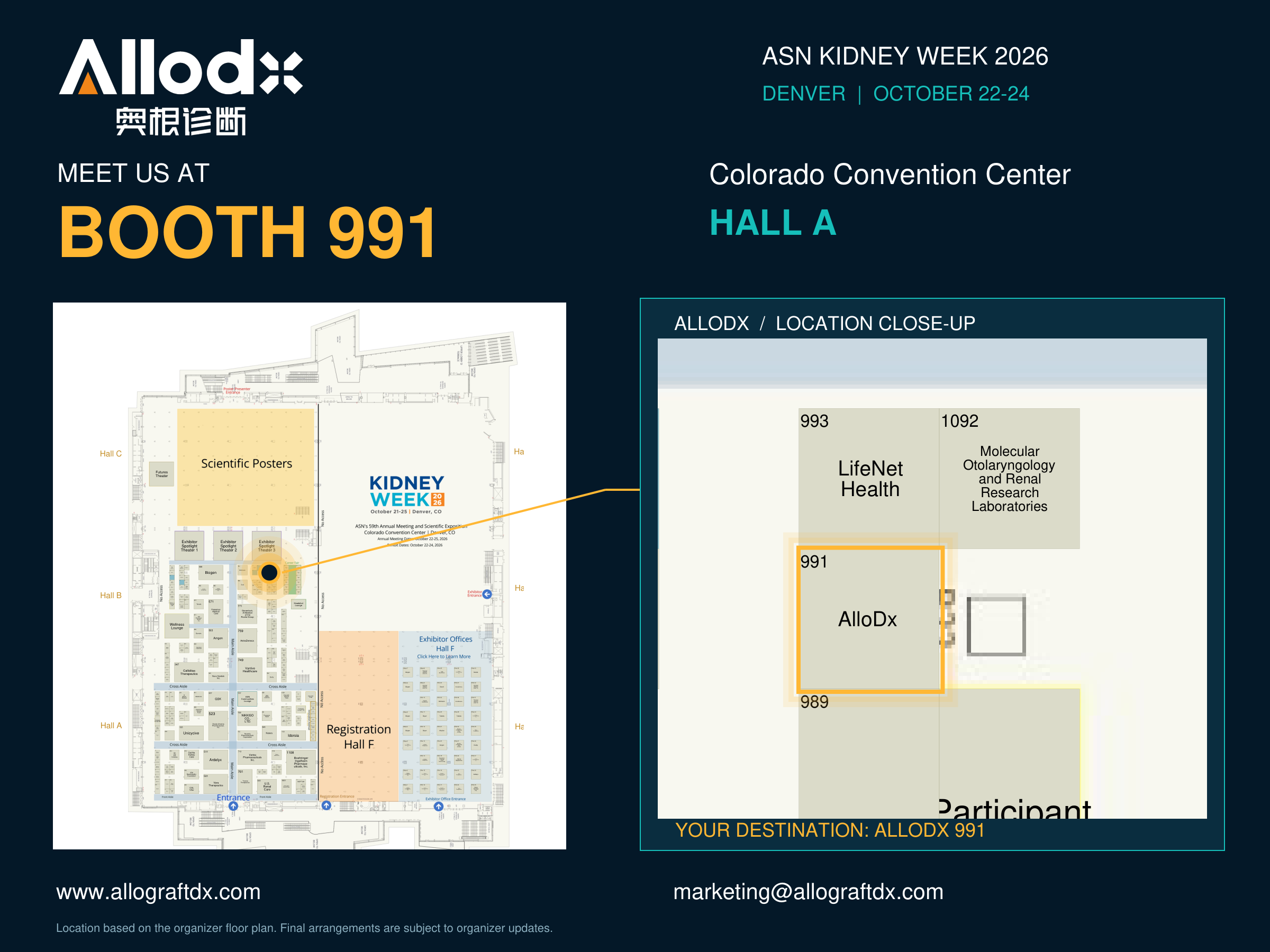
On October 22–24, 2026, AlloDx will present three key assay kits — anti-Nephrin autoantibody, sC5b-9 and C3NeF — at the ASN Kidney Week 2026 scientific exhibition in Denver, USA. Welcome to Colorado Convention Center, Hall A, Booth 991, to explore advances in kidney immune testing and research collaboration with the AlloDx team.
Building on in-house assay methods and core antibody development, AlloDx serves the global high-level kidney research and professional testing market, focusing on recognition specificity, low-abundance detection and quantitative standardization, translating technological innovation into every key measurement step.
Join us at
Colorado Convention Center
Hall A · Booth 991
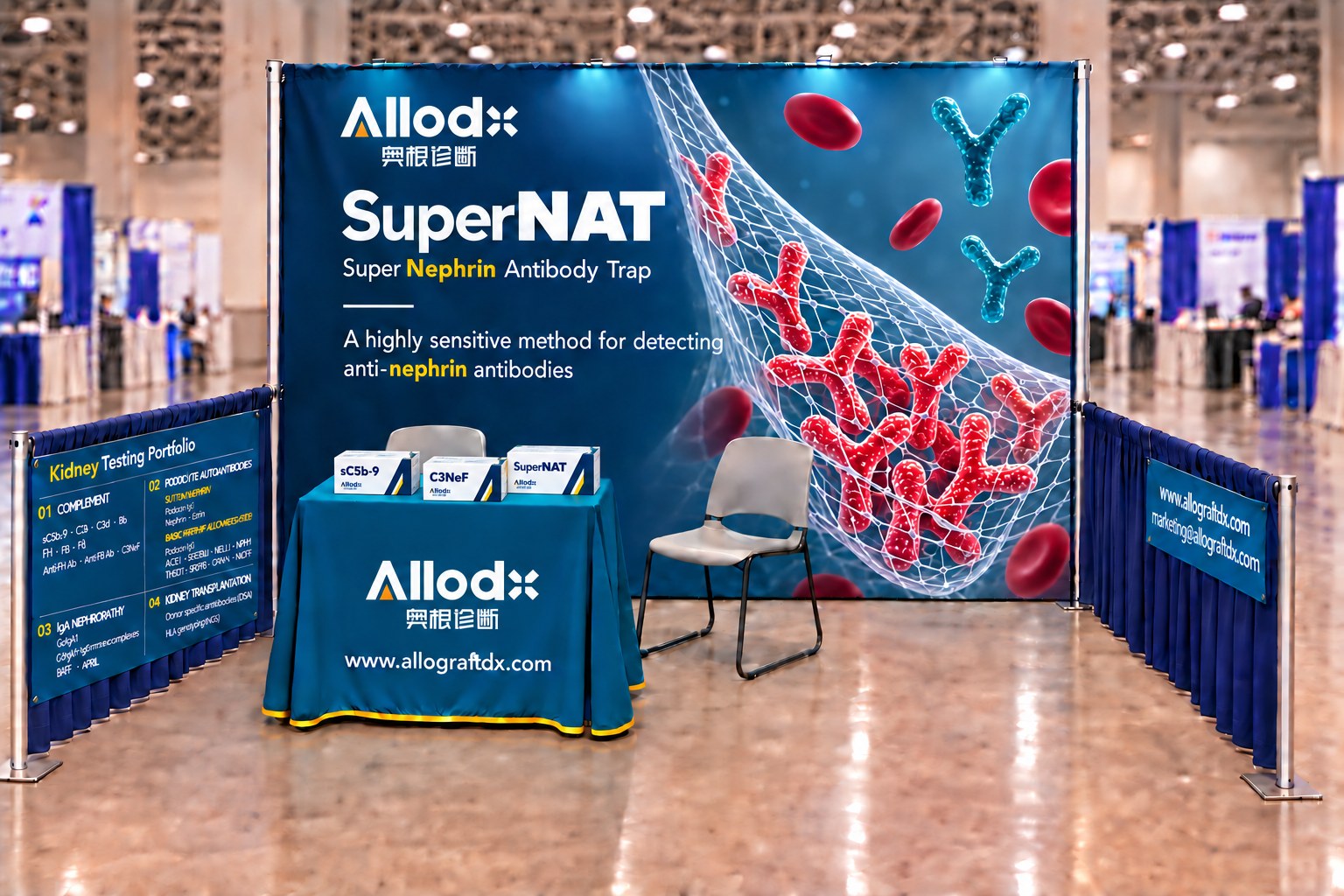
AlloDx ASN 2026 booth design rendering
C3NeF: advancing quantitative testing with recombinant monoclonal antibody calibration
Further development of the C3NeF test requires an explicit calibration relationship between assay signal and quantitative results. At this exhibition, AlloDx will highlight research on a magnetic-bead quantitative assay using a recombinant C3NeF monoclonal antibody as the calibrator.
This method uses C3b-coupled magnetic beads as the reaction matrix, controls background through signal subtraction between test and control wells, reads binding signals with anti-human IgG, and converts sample results via the monoclonal antibody standard curve. The monoclonal calibrator provides a definable, reproducible calibration source for the assay, laying a methodological foundation for subsequent lot control and comparison of research results.
The C3NeF testing technology independently developed by AlloDx achieves a serial calibration range of 18.75–1200 ng/mL and has conducted validation around reference standards, curve calibration, and sample measurement, to advance C3NeF testing toward more standardized quantification.
Meanwhile, the R&D system is also exploring the use of Bb retention on magnetic beads to assess convertase stabilization. The IgG-binding readout and the Bb-retention readout provide complementary immune-binding and functional information. The current standard curve corresponds to the indirect IgG method; the two readouts remain distinct in methodology and result interpretation.
From calibrators to assay systems, and from binding signals to function-related readouts, AlloDx focuses on building more interpretable measurement tools for C3NeF research.
sC5b-9: AD99, recognizes the C9 neoepitope
The key to terminal complement activation testing lies in recognizing the structural features that emerge after complex formation. The core of AlloDx's sC5b-9 assay kit is the AD99 monoclonal antibody targeting neoepitopes of the polymerized C9 conformation.
According to AlloDx R&D data, the target epitope of AD99 is formed jointly by adjacent C9 subunits, located at the conformational interface between C9 and C9. Rather than simply recognizing a single complement component, this design focuses recognition on the structural changes generated by complex assembly.
In the double-antibody sandwich ELISA system, AD99 serves as the capture antibody while the detection antibody recognizes C5b. The two antibodies establish a paired readout from distinct structural sites, making "what molecular structure is recognized" the core of the assay design.
For AlloDx, the value of core antibodies runs through target epitope selection, antibody screening and assay development. Based on AD99, the sC5b-9 product serves research on terminal complement activation, providing testing tools for exploring kidney disease mechanisms and complement intervention studies.
SuperNAT: enhancing detection of weak-signal identification
Anti-Nephrin autoantibodies offer a new dimension for research on podocyte-related diseases. Facing low-abundance targets and complex sample backgrounds, SuperNAT (Super Nephrin Antibody Trap) combines magnetic-bead capture, enrichment washing and background subtraction, building the testing workflow around "making the target signal clearer".
Magnetic-bead capture and enrichment:Through antigen–antibody binding and magnetic separation, target antibodies are concentrated into a detectable reaction system, providing methodological support for low-abundance antibody detection.
Background subtraction and interference control:Background correction is incorporated into the readout workflow; existing R&D data also include interference assessments under hemolyzed and high-triglyceride sample conditions, reflecting the complexity of real-world samples.
Reproducibility and longitudinal research:The data report an intra-run CV of 6.8% and an inter-run CV of 10.4%, providing preliminary support for repeated measurements under the tested conditions. Longitudinal studies of antibody level changes will help further explore their relationship with disease phenotype and course.
SuperNAT detects anti-Nephrin autoantibodies. With clearer target recognition and a more stable testing workflow, AlloDx aims to support research on minimal change disease and related podocyte diseases, helping cutting-edge biological findings move into measurable, verifiable research practice.
Gathering at ASN Kidney Week 2026
The three products reflect AlloDx's sustained commitment to kidney immune testing: SuperNAT improves signal discrimination for low-abundance autoantibodies, AD99 targets neoepitopes of complement complexes, and recombinant monoclonal calibration advances quantitative C3NeF testing.
Facing the needs of international high-level research, AlloDx looks forward to in-depth exchanges with global nephrology experts, research institutions and professional partners on methodological validation, clinical sample studies and international collaboration.
October 22–24, 2026, Denver, USA. Hall A · Booth 991 — AlloDx looks forward to meeting you there.
Some original figures, videos and downloadable materials are provided in Chinese.