
The recurrence rate of liver cancer can reach 20%~57.8% 5 years after liver transplantation. The application of calcineurin inhibitor (CNI) is an independent risk factor for the recurrence of liver cancer after liver transplantation. When the recipient is in a strong immunosuppression state, the immune monitoring system is destroyed, promoting tumor recurrence and metastasis, and insufficient CNI dosage can easily induce rejection. How to maintain this balance is yet to be determined. Therefore, good detection methods and predictive indicators are needed to monitor tumor recurrence.
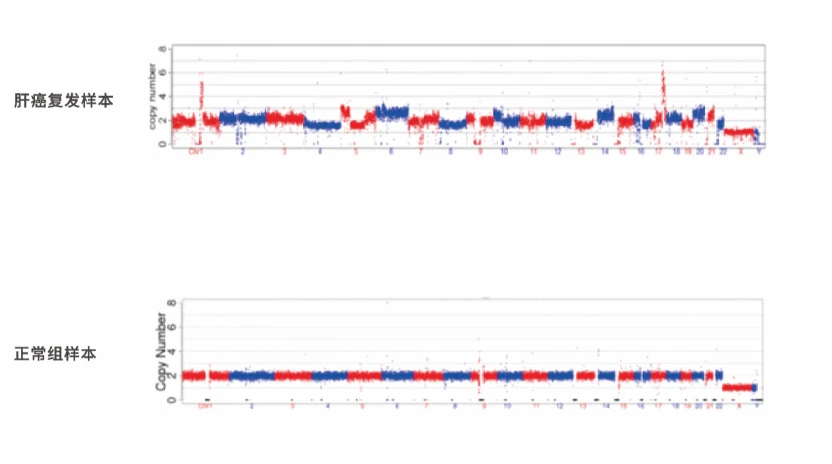
Chromosome copy number variants (CNV) are an important feature of tumorigenesis. When tumors develop to a certain stage, due to excessive cell division and abnormal mitosis, chromosomes cannot be properly distributed to daughter cells, resulting in abnormal chromosome copy number.
CNV analysis. The five samples represent 5 different groups respectively: HCC with tumor <= 30 mm, HCC with tumor 31-50 mm, HCC with tumor >50 mm, cirrhosis, and chronic hepatitis[1].
This product is based on plasma cfDNA whole genome sequencing, using normal people as the training group, and analyzes the relative deviation values (Z values) of different chromosomes in the entire genome of the tester, indicating whether chromosome copy number variation occurs at a specific location. Z value >3 indicates an increase in copy number. Z<-3 indicates copy number reduction.
References
[1] Hongtao Xu,Xia Zhu, et al. Non-invasive Analysis of Genomic Copy Number Variation in Patients with Hepatocellular Carcinoma by Next Generation DNA Sequencing.J Cancer.2015;6(3):247–253. doi:10.7150/jca.10747