
AlloDx Kidney Transplant dd-cfDNA Research Cited in a Nature Portfolio Journal
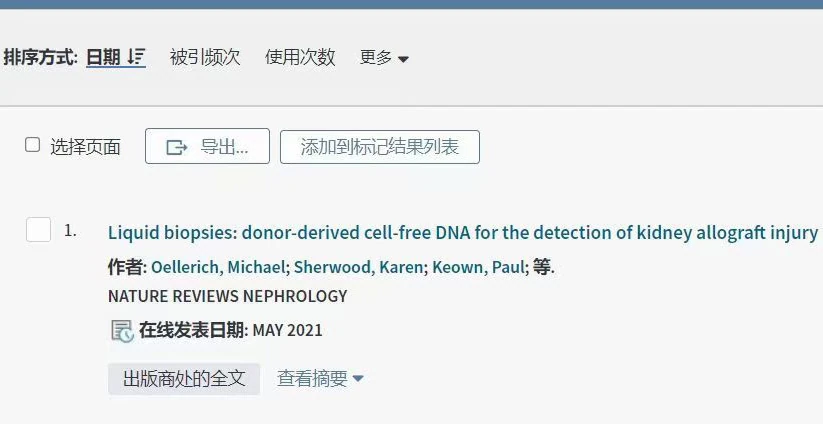
An early paper on the detection technology of kidney transplant donor-derived cell-free DNA (ddcfDNA) by the AlloDx team, a cooperative unit of the center, was cited once by a Nature sub-journal published in May.
AlloDx is currently the only ddcfDNA detection platform derived from kidney transplant donors recognized by the international medical community in China. It is based on a second-generation gene sequencing platform and uses independently developed ID-Tag. seq technology, by enriching cfDNA and reducing background noise interference, reduces the background error of second-generation gene sequencing by 1,000 times, achieving high-precision detection of one-thousandth low-frequency mutations at ultra-high sequencing depth, capturing and detecting patients' ddcfDNA, and combining it with the bioinformatics quantitative model HQ-NIT to evaluate the severity of the patient's rejection reaction.
"Nature" is one of the oldest and most prestigious scientific magazines in the world. Its purpose is to "display important discoveries in scientific research to the public and let the public know as early as possible the progress made in every branch of natural science around the world." Unlike most scientific magazines today that focus on a special field, it publishes first-hand research papers from many scientific fields. In many fields of scientific research, many of the most important and cutting-edge research results are published in the form of short messages in Nature.